Believe it or not, the reason I got into programming in Java & on Minecraft was to work on anticheats. As an avid player of the late Mineplex network since early 2015, watching the network become further and further plagued with cheaters became quite disheartening. That only got worse after I became a moderator in 2018, and again in 2020 where the depth of the issue was made obvious. Mineplex, in 2016, had one of the top anticheats built for it ever seen... GWEN! However shortly after its phase 2 release, it saw extremely sparse updates from developers not affiliated with the original project who made spotty changes at best. In 2020 when I became a Java moderator for the network, I started learning Java with the hope of one day being able to make an anticheat myself, and possibly work on GWEN. The cheat clients grew in popularity massively, cheating became an epidemic, and whether it was blatantly obvious, or in secret, it seemed that everyone had some sort of link to a cheater. It was difficult to find games without them. GWEN was very good at figuring out who was using combat cheats, such as Reach, Killaura and using an autoclicker, but it was programmed to use a banwave feature that was rarely executed which caused most cheaters to fly under the radar. GWEN was also totally unable to stop movement cheaters, allowing bunny hop players, people with flight and so much more to run rampant. Once the leadership team figured out that GWEN wasn't working as well as it once did, the QA moderation team was given the resources to see the advanced information that would allow them to ban players for less-obvious cheats - but guess what, not one of them ever did, and god forbid you pinged one to ask for a review.
Now obviously as of writing this, 5 years on, we know that GWEN never really saw a proper update before Mineplex was on its downward spiral. A year before the closure of the Mineplex network, the single developer still working on the network pushed many updates to the anticheat, removing the banwave feature, lowering the thresholds, and most importantly, allowing GWEN to monitor movement cheats. GWEN was top of the range again, but the cheaters had become so dominant in the community, that Mineplex couldn't survive blocking the freedom of their now mostly-cheating community.
This is what caused me to abandon anticheat development on Minecraft. I developed MAC for the Mutinies network privately, but development on it stopped once the codebase was redone. Here's some of the very early development of MAC!
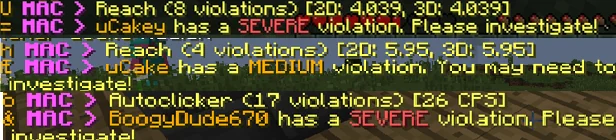
MAC was originally able to detect most combat cheats and some movement cheats with no issue, using various checks for each, these included:
- Killaura
- Reach
- Autoclicking
- Timer
- Flight
- TP-Flight (a certain NCP bypass that would allow a brief burst of flight after a player teleport)
- Bunny Hop
- High Jump
- ...and a few others!
If resources were retained to continue the development of MAC, it could have been quite a strong anticheat for its time. MAC allowed you to view anticheat information in extreme amounts of detail, ranging from the exact parameters of violations (reach range, click speed, head snap distance), how many there were, leniency by ping, and having a system that would calculate possible cheaters without them making any violations. This was usually through new accounts, MAC extreme prejudice which detected alternative accounts with violations or anticheat bans on the same IP (inspired by GWEN Extreme Prejudice or GEP), and packet watching.
One of the biggest challenges we had during the creation of MAC was false positives. If you were punished automatically by MAC, either by banwave or by instant ban, you'd be given a code in the ban reason that could be used to track violations that lead up to the punishment which was extremely effective in appeals. The big aim we had was to find the balance between accuracy and playability. MAC had a tuning system that allowed staff to adjust thresholds for checks there and then, as well as regionally set thresholds depending on server type, playerbase, game, and even geographical region. For example one of our glide checks would falsely alert sometimes if players had over a certain amount of ping, a similar issue happened with reach violations simply down to latency. MAC was able to account for these by dynamically scaling violation thresholds based on player connection quality, which greatly reduced the false positives without making the system too lenient.
MAC wasn't just about detection, it was about giving the staffers using it the right tools. This paired with the Profiler also mentioned on this portfolio, suspicious players could be flagged before even getting into a game, with their data stored for review. Moderators could view timelines of violations, graphs of reach or click patterns, and note information tied to player accounts. This meant bans could be both fast, and more accurate, and allowed for bans based on clear evidence rather than vague suspicion.
In the later versions of MAC, low severity violations would raise silent alerts, allowing moderators to observe without tipping off potential cheaters. Consistent or extreme violations would push a case into an 'auto-ban' queue, while specifically marked servers could opt for instant bans to maintain competitive integrity. This approach was used as we wanted to avoid cheat developers being able to guess our thresholds by slowly increasing cheat settings until they get a ban. With the banwave, they always came randomly unless a player was deliberately setting off every check.
Despite the effectiveness of the anticheat, MAC faced many of the same limitations that every anticheat does: the constant arms race between developers and cheat developers. Every update required new changes, new thresholds, and every bypass needed a more creative solution. Still, for the time it was active, MAC provided a reliable backbone for fending off cheaters, which gave moderation staff a good alternative to the pre-existing solutions of finding something on SpigotMC that wasn't built for Mutinies.